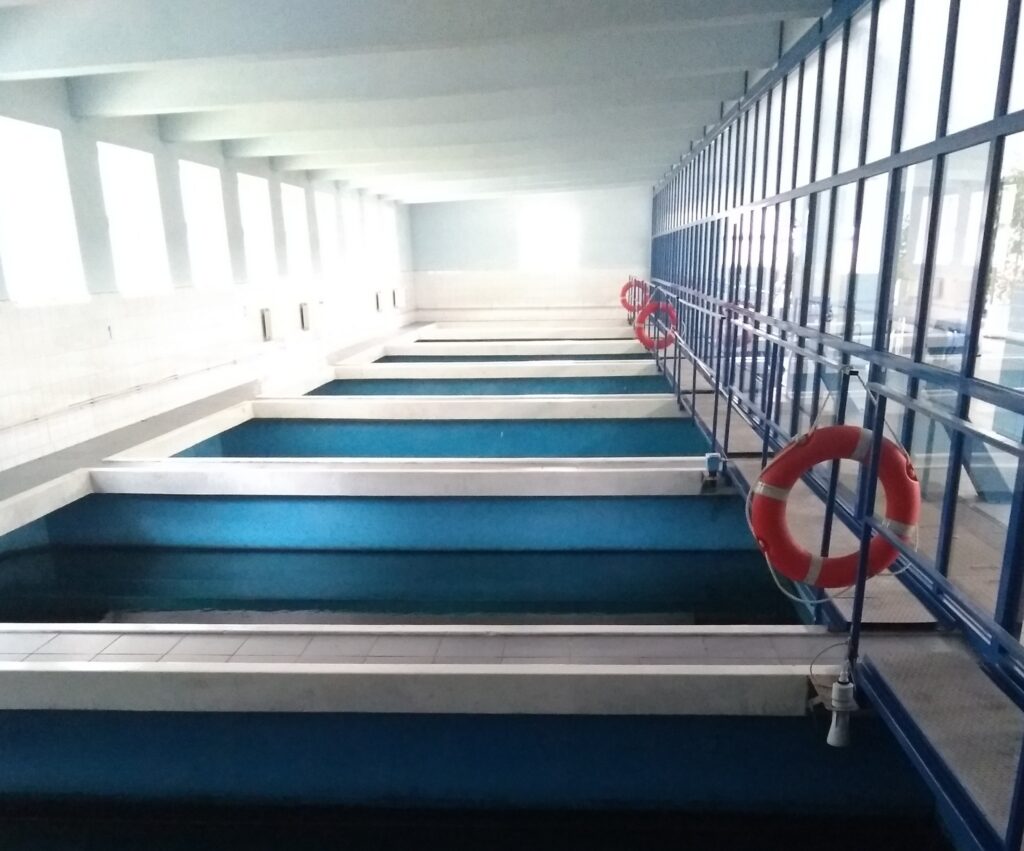
Waterworks (9): the carbon filter hall
Sounds recorded as the water goes through carbon filters. Filtration on a bed with active carbon improves the colour and taste of…


Since 1941 Siemens has been producing telephones in the small town of Bocholt, Germany. Today there are still 550 workers making cordless telephones for Gigaset, which separated from Siemens and started producing the first smartphone made in Germany. While the individual electronic parts for the GS185 smart phone are still being imported from Asia the finished product is put together in Bocholt. The special thing about the production is that the phone is put together by 8 employees at a time in a U-production-line with the help of robots by the company Universal Robots. These digital colleagues are involved in some of the production processes that need high technical precision. Other tasks that need more sensitivity are executed by employees.
In this recording you can hear how an employee and a robot place the mainboard and the microphone into the phone and connect them with the display. The employee places the phone into a small tray that keeps it in place and removes a couple of protective foils, then she touches the robot, which has built in sensor, to start the process. With the pneumatic gripper the robot picks up the mainboard and places it into the phone until a clicking noise signals that it is connected. Then it picks up the microphone from a tray next to the phone and connects it, too. Having completed the working process, the robot starts preparing for the next phone. Meanwhile the employee moves the previous phone to the next stage in the U-production-line. Then robot picks up the pneumatic gripper again, takes another mainboard from the supply and waits for the touch of an employee to start the process all over again. The robots make hardly any noise. Only the ventilator of the U-production line, the smacking sound and air stream of the pneumatic gripper and the clicking when the mainboard and the microphone are being connected can be heard.
Sound: Kathinka Engels
Photo/Video: Inke Pickhardt
Sounds recorded as the water goes through carbon filters. Filtration on a bed with active carbon improves the colour and taste of…
The Goričane company originates from one of the oldest Slovenian paper mills, established in 1740. The company has been producing paper at…
In December 2018 Prosper Haniel, the last active coal mine of the Ruhr area, was closed down. Before the end “Sounds of…
This recording is a soundscape from Joensuu art museum. You can hear people walking and talking in the halls that echo. Museum…